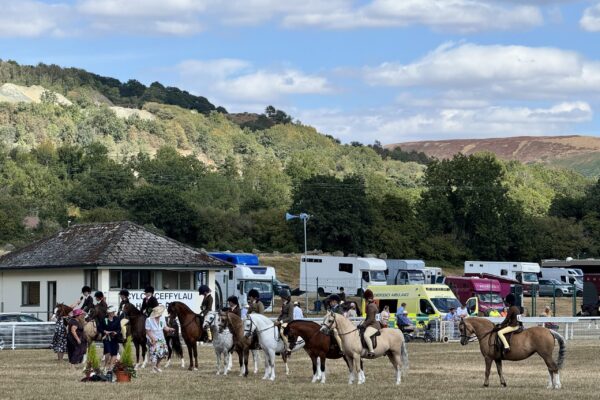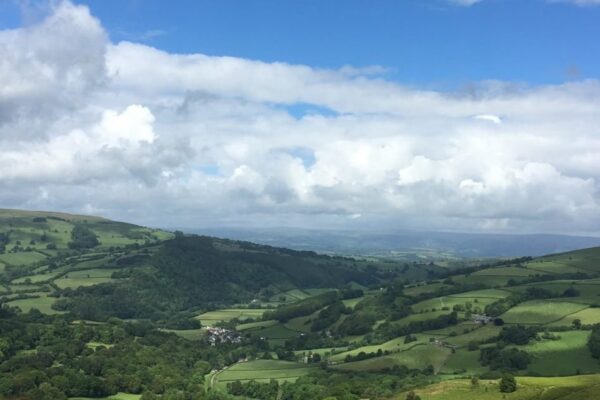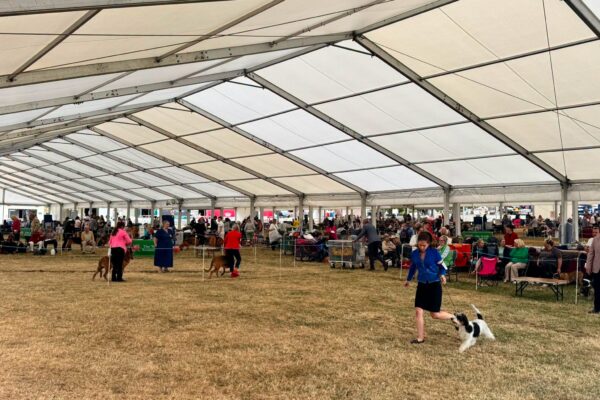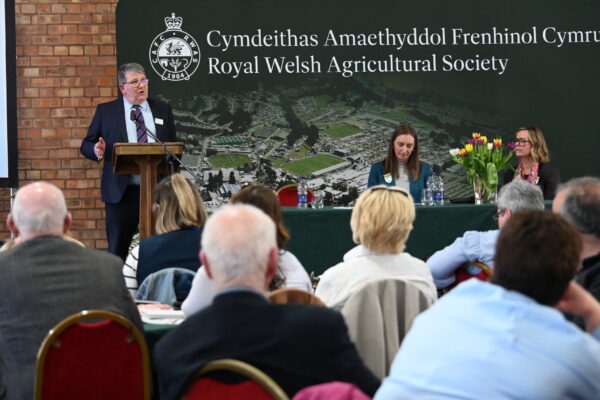
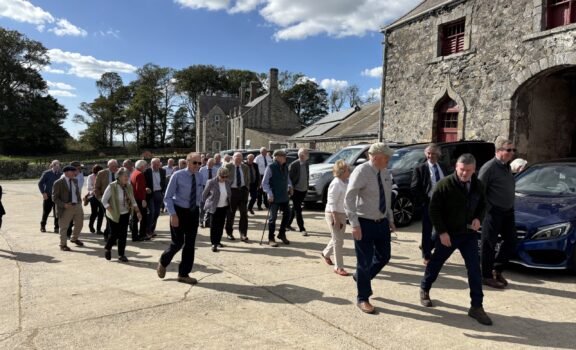
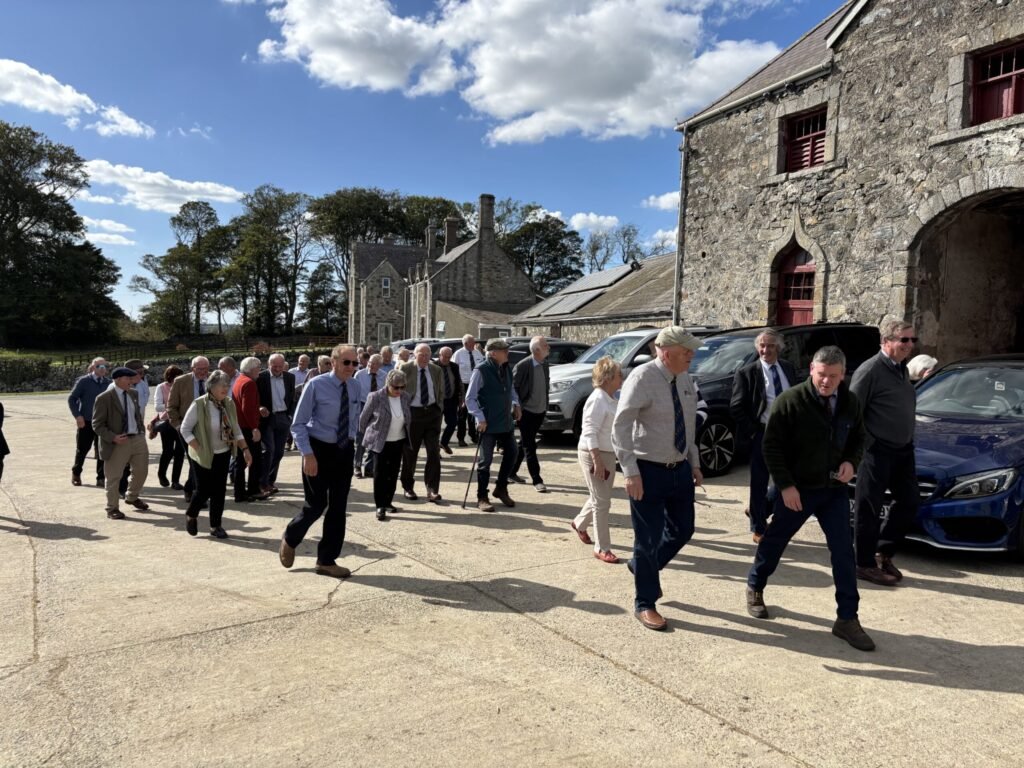
Glorious early Autumn weather, the backdrop of Eryri and a great turnout distinguished the CARAS Cymru Council meeting and lunch at the Anglesey County Showground. The scene was set for the visit to Castellior, Menai Bridge, a muti award winning intensive beef finishing unit.
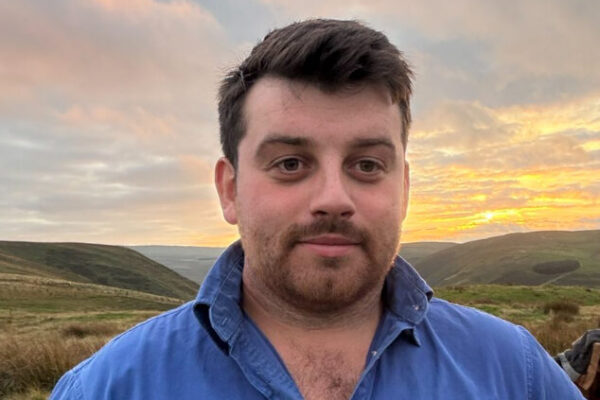
The 800 acre Anglesey farm’s journey towards net zero has won Dylan Jones many awards. He is the British Grassland Farmer of the Year, Farmers Weekly Beef Farmer of the Year 2024 and winner of the RWAS 2024 Sir Bryner Jones Award.
Dylan explained that the plan to become 100% self sufficient was developed in 2016. Previously he and his father, Wyn, were finishing 700 cattle a year, lambing 900 sheep and purchasing all feed apart from the 51ha of barley grown on the farm.
He says: “We’re buying in all our cattle between at 15 and 24 months of age and we sell them at between 22 and 30 months. It’s intensive, but I’ve done lot of work over last ten years with Bangor University and Farming Connect – it’s an open book so others can follow our journey to Net Zero
“I wanted to prove that, as intensive beef farmers, we could reach Net Zero, to prove that beef production here in Wales can be beneficial for feeding the public and reaching environmental goals. We are extremely proud of the work we have done over the last ten years to prove this. It is so beneficial for the environment.”
Dylan is the third generation at Castellior. He began by illustrating that the fundamental farming practice hadn’t changed since the days of his grandfather, who with his brothers had lost their father at a very young age.
Technology had moved on since the three young men had to build by hand, with no instruction booklet, a combine gifted by the Canadian Government during World War 11. It was delivered to the port at Menai Bridge in boxes of parts, nuts, belts and bolts!
He said: “Just think what they had to go through to build that combine! They weren’t sure what they were doing, but they built that combine on the yard, Today we’re following the fundamental basics of their farming. We’re doing basically the same as my grandfather Technology has moved on in leaps and bounds, but the fundamental farming practice is still there.
“We grow the crops to feed the stock to get the muck to grow the crops. That’s basically what they were doing and exactly what we do today. The blueprint of what my grandfather was trying to do still works today. We are rearing cattle on homegrown grains and homegrown grass.”
The farm is run entirely with an in house work force, the family with one full time and two part time workers. It finishes 1,600 head of cattle annually on a self-sufficient, low carbon system balancing innovation and environmental responsibilities for a sustainable, profitable beef enterprise. The cattle are mainly dairy crosses, sourced from Wales, locally where possible, at between 15/24 months of age and finished on a 100% home grown total mixed ration of grass, legumes and cereals.
Dylan stressed the importance of attention to detail and innovation. He explained how livestock management software is used to manage herd performance and monitor cattle growth rates. Cattle are weighed every week, with a target daily liveweight gain of 1.6 to 1.8kg to reach a finished liveweight of 610–650kg. The regular monitoring of weight gains gives an indication of the efficiency of the diet and the need for adjustments to gain optimum performance.
He explained the farm has become self sufficient in terms of feed by introducing red clover as the protein source in the two to three year rotations. The cereals are mainly a combination of winter and spring varieties, providing the starch in the diet and straw for bedding, with 110 acres of winter barley, 220 acres of spring barley and 20 acres of summer barley for crimping. Dylan outlined the importance of red clover, ‘a plant that keeps on giving’ and the need to incorporate as much protein as possible in the feed.
The clover produces the same 21/23% protein as peas and is less expensive to grow as well as providing more bulk. The peas are harvested two to three weeks early, so increasing moisture content from 15/16% to 25/35% moisture. The silage is all clamped.
Farmyard manure is vital to maintain soil organic matter and, with effective soil incorporation, it reduces the need for purchased nitrogen. New cropping techniques and more effective use of nutrients, means the farm has reduced its carbon footprint, achieving a score of 3.9kg CO2e/kg of cattle liveweight in the Farming Connect Carbon Footprint Audit, compared to the Welsh average of 18kg for beef finishing farms. The farm has been involved with Bangor University, Farming Connect and ABS Prism 2030 in preparation for the anticipated future markets.
Farm Facts
- 324ha farmed, 243ha owned
- 2,000t of silage harvested annually
- Total mixed ration: 7kg crimped barley, 2kg red clover silage, 2kg Westerwold silage, 5kg high-protein silage and 0.5kg straw
- 1,600 dairy-cross stores finished annually
- 150 cattle weighed weekly
- 28-30 months age at finishing
- Average of 122 days-to-slaughter
- Cattle supplied monthly to ABP